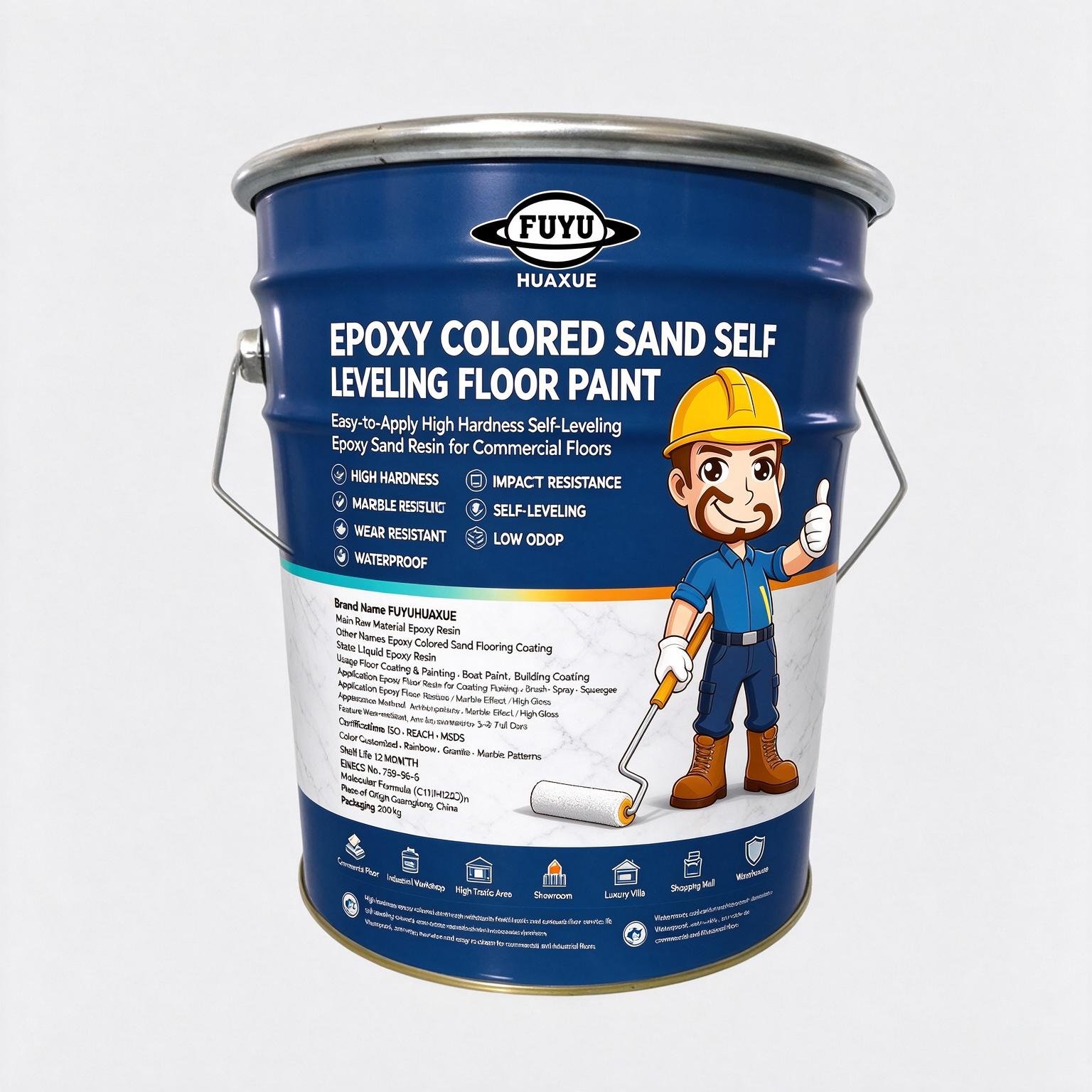
A commercial flooring project rarely fails on the day it is installed. It fails in the weeks before—in the schedule meeting where the floor is squeezed between ceiling grid and final clean, in the change order that adds a day of sanding because the trowel marks did not flow out, in the phone call from the owner asking why the space cannot reopen on Monday. The floor is the last trade in and the first constraint out. Every hour it consumes is an hour subtracted from someone else’s margin.
That is the context in which self-leveling colored sand epoxy deserves a closer look than it usually gets. It is not simply a decorative coating. It is a schedule instrument, a labor multiplier, and—increasingly—a compliance document. The global epoxy flooring market was estimated at USD 4.72 billion in 2026 and is projected to reach USD 7.60 billion by 2033, growing at a CAGR of 6.4%, driven by demand for durable, chemical-resistant, and aesthetically capable surfaces across commercial, industrial, and residential sectors. But the number that matters most to the people specifying and installing those floors is not the market size. It is the number of procedural steps a floor removes from the critical path.
The Labor Equation Nobody Prices Correctly
Self-leveling epoxy does one thing that conventional trowel-applied systems cannot: it flows. The applied material levels under its own weight and low yield stress, erasing trowel ridges and brush marks without the mechanical sanding that would otherwise consume crew hours and generate dust. In a colored sand system, the graded quartz aggregate is carried within that flow, settling into a dense, continuous matrix rather than sitting on the surface as a broadcast that can dislodge under traffic.
The productivity consequence is not marginal. A self-leveling epoxy screed can be installed at rates of up to 1,000 square meters in a single day where schedule pressure demands it, because the material does the leveling work that would otherwise fall to the trowel. Sika positions its self-smoothing topping explicitly on “easy and fast application—minimises downtime,” with a solvent-free profile and a dense, impervious, seamless surface that is easily cleaned and requires limited maintenance. In the language of the jobsite, that translates into fewer passes, fewer skilled hands required per square meter, and a shorter interval between the last pour and the first walk-on.
Walk-on time of 24 hours and full cure within three to seven days completes the operational case. In a retail fit-out or a workshop bay, the difference between a floor that accepts traffic tomorrow and one that demands a week of closure is not a line item in a spreadsheet. It is the difference between a project that holds its opening date and one that renegotiates it.
Durability Is a Specification, Not a Claim
The colored sand format earns its place in high-traffic environments because of what the aggregate does to the film, not what it does to the brochure. Graded quartz is hard. Densely packed into an epoxy matrix, it produces a composite surface that resists the two failure modes that degrade ordinary coatings: abrasion and impact. The specification positions the system for frequent forklift and heavy-vehicle traffic without powdering or peeling, with a service-life extension of more than 30% relative to ordinary floors.
That figure is consistent with how the market uses quartz-filled systems in practice. In a Minnesota agricultural equipment dealership, a decorative quartz system was selected for a showroom required to withstand “thousands of pounds of heavy farm equipment such as tractors, mowers and excavators” while maintaining a classy aesthetic. Two years after installation, the floor remained pristine under heavy-duty equipment and foot traffic. In London’s Covent Garden, Brompton Cycles specified an epoxy quartz resin screed for its flagship store specifically because the floor had to survive “constant foot traffic, bicycle movements, and daily retail operations” while complementing a premium showroom appearance; the finished system delivered abrasion resistance, chemical and stain resistance, and a seamless hygienic finish. The lesson from both projects is the same: the decorative aggregate is not a sacrificial layer. It is the wear surface, and it is the reason the floor does not need to be replaced on the retail cycle.
The seamless character of the cured film adds a maintenance dimension that facility owners feel long after the contractor has left. A floor without joints offers no purchase for oil, water, or mild acids and alkalis to penetrate and no grout lines to harbor residue. Stains wipe away rather than soaking in. For spaces where cleanability is operational rather than cosmetic—food-adjacent areas, healthcare corridors, workshops handling lubricants—that impermeability is a functional property, not a selling point.
The Aesthetic That Does Not Compromise the Specification
Decorative epoxy has spent years fighting a credibility gap: it has been seen as a functional floor dressed up, rather than a genuine design material. The self-leveling colored sand format narrows that gap because the aesthetic is a direct product of the performance structure. The natural stacking of graded quartz, distributed through a self-leveling film, produces a depth and variation that reads as stone rather than paint. Marble-like and granite-like effects emerge from the aggregate blend and flow behavior, not from a printed overlay that wears away under traffic.
The specification reflects that dual identity: appearance options span colored sand texture, marble effect, and high gloss, with color customized across rainbow, granite, and marble patterns. The same product family can shift from a high-gloss showroom floor to a more subdued sheen in a production area without changing systems. For a building with a public face and a back-of-house, that coherence is operationally useful. It reduces the number of products a facility manager must stock, the number of application procedures a crew must master, and the number of warranty interfaces that can fail where one system meets another at a doorway.
The Regulatory Clock Is Already Running
No serious conversation about floor coatings in 2026 can ignore the direction of environmental regulation. China’s GB 30981.1-2025, which took effect on June 1, 2026, brings floor coatings under mandatory control for the first time and sets VOC limits at 120 g/L for waterborne floor coatings, 500 g/L for solvent-borne, and 60 g/L for solvent-free systems. Critically, the standard extends mandatory testing to auxiliary materials—putties, color pastes, and curing agents—for the first time. The regulatory logic is straightforward: it is no longer enough for the resin to be low-VOC if the hardener or the pigment paste is not.
A low-odor, low-VOC self-leveling colored sand system is positioned on the right side of that trajectory. The specification aligns with REACH and VOC-oriented standards, and the formulation is designed for the regulatory environment the market is entering, not the one it is leaving. That matters beyond compliance paperwork. Floor installation frequently happens in occupied or partially occupied buildings—schools during holidays, hospitals with active wings, retail spaces where adjacent tenants cannot be displaced. A material that can be applied with minimal environmental impact and brought into service quickly reduces the coordination burden on the entire project team. When the same material delivers wear resistance, anti-slip texture, and a seamless surface, the sustainability conversation stops being a constraint and becomes a specification advantage.
The industry data confirms the direction of travel: waterborne and solvent-free systems are gaining share as mandatory standards tighten and green building preferences harden, and manufacturers without the formulation capability to adjust are exiting the market. Specifying a waterborne-compatible colored sand system is not an environmental gesture. It is a hedge against a specification that could become non-compliant before the floor is due for renewal.
The Anti-Slip Detail That Quietly Matters
One of the least discussed advantages of colored sand systems is also one of the most consequential in real buildings. A smooth, glossy epoxy floor becomes hazardous when wet. The colored quartz structure provides a natural micro-texture that delivers traction without the aggressive, difficult-to-clean profile of a heavy broadcast. In commercial kitchens, locker rooms, workshops, corridors, and wet-process areas, that distinction is the difference between a floor that meets slip-resistance expectations and one that becomes a liability waiting to happen. The texture is integral to the film rather than applied on top, which means it does not wear away preferentially in the traffic lanes where traction is most needed. The anti-slip function is specified as a built-in feature of the colored sand structure, not an additive bolted on after the fact.
What the Floor Is Worth Over Time
The case for self-leveling colored sand epoxy is not that it is the cheapest floor per square meter at the moment of purchase. It is that the cost of a floor is never the cost of the coating alone. It is the cost of application labor, the cost of downtime, the cost of maintenance, and the cost of premature replacement—all discounted over a service life that, in a properly specified and installed system, is measured in years rather than seasons.
A product that levels itself reduces the labor line and compresses the schedule. A product that resists abrasion and impact extends the replacement interval, as the showroom and retail cases demonstrate. A product that wipes clean reduces the maintenance burden. A product that meets the incoming environmental standard avoids the risk of a specification that ages out before the floor does. And a product that produces a marble-like, seamless surface gives the owner something functional floors rarely provide: a surface that does not need to be explained away to a client, a tenant, or a brand team.
The flooring industry does not need another coating. It needs systems that behave predictably when the site is imperfect, the crew is average, the schedule is short, and the regulatory bar is rising. Self-leveling colored sand epoxy is not a universal answer, and no responsible supplier would present it as one. Concrete moisture must be assessed. Surface preparation must be done. Mixing ratios and ambient conditions still govern the outcome. But within those constraints, the convergence is clear: a chemistry that flows where it should and holds where it must, an aggregate that wears without failing, a surface that reads as designed rather than merely applied, and a formulation that moves with the environmental standard instead of against it. The floor, finally, stops being the reason the project runs late—and starts being the reason it holds together.