There is a version of the epoxy floor failure story that contractors tell quietly, usually after the client has left the room. The floor looked fine on the day it was poured. Six months later, it had developed a mottled, patchy appearance—lighter here, darker there, as if the color had been applied with a spray gun rather than mixed into the material. Or worse: the surface began to delaminate in sheets, not because the product was bad, but because the ratio was slightly off, or the sand was added by the bucket rather than by weight, or the crew was rushed and the dispersion never reached homogeneity before the material started to gel.
The flooring industry has spent decades improving resins, hardeners, and aggregates. It has spent far less attention on the one variable that sits between all three and the finished floor: the mixing bowl. Pre-blended colored sand epoxy systems exist to remove that variable. And for the applications where they are specified—garages, workshops, warehouses, showrooms—the removal of mixing variability is not a convenience. It is the difference between a floor that performs as designed and one that becomes a callback.
The Case for Taking the Sand Out of the Crew’s Hands
Colored sand epoxy is not a new category. What is new is the recognition that the point of blending matters as much as the blend itself. In a conventional system, the colored quartz aggregate is added on site: Part A resin, Part B hardener, and a measured quantity of sand, combined by a crew working against a pot life clock. The procedure is straightforward in principle and fragile in practice. The sand must be added at the correct ratio, dispersed uniformly, and mixed long enough to eliminate dry pockets without entraining excessive air. Each of those steps is a point where a rushed or undersupervised crew can introduce variation that will not be visible until the floor is cured.
A pre-blended system collapses that procedure into two components. Part A arrives from the factory already containing the colored quartz sand, dispersed in the epoxy resin at a controlled ratio. Part B is the transparent curing agent. The on-site task reduces to combining A and B in the specified 8:1 ratio by weight and mixing to a uniform consistency. The sand is already where it needs to be, in the proportion the formulation was designed around, distributed as evenly as a factory mixer can achieve. The contractor is no longer responsible for the aggregate ratio. The contractor is responsible for the A:B ratio and the mixing time. That is a shorter list of failure points, and a shorter list of things that can go wrong between the pail and the floor.
The industry has begun to describe this shift in explicit terms. Solvent-free, pre-mixed epoxy colored sand self-leveling systems are positioned as requiring “only the addition of Component B (curing agent) on-site, ensuring structural stability and uniform color,” with no need for on-site sand loading. The advantage is not merely labor savings, although that is real. It is consistency: the color distribution that a client approves in a sample is the color distribution the floor delivers, because the blending happened under controlled conditions rather than in a bucket on a jobsite.
There is a counterargument worth acknowledging honestly. Pre-mixed systems can settle during transit and storage, and a pail that has been sitting in a warehouse for months may require thorough redispersion before the hardener is added. That is a real handling consideration, not a disqualifying flaw. The response is not to abandon pre-blending but to specify a product whose settled portion is easily redispersed and to instruct the crew to mix Part A to homogeneity before combining. A pre-mixed system that is properly handled removes more variability than it introduces. A conventional system that is improperly handled introduces variability at every step.
Compressive Strength Is the Number That Determines Whether the Floor Survives the Vehicle
Garage and workshop floors are not judged by how they look on the day of completion. They are judged by whether they still look intentional after a decade of parked cars, rolling jacks, dropped tools, and the slow, grinding abrasion of tires turning in place.
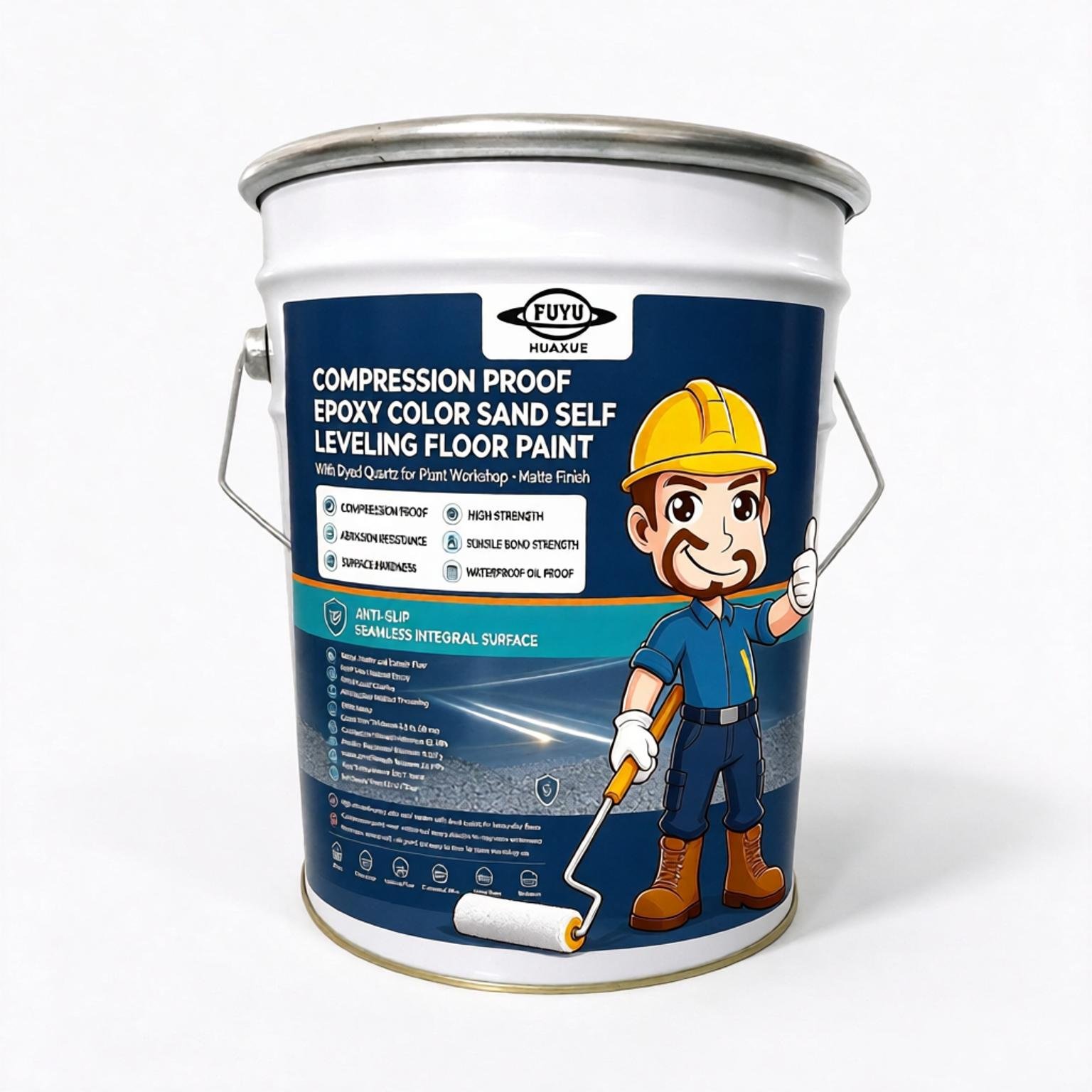
The specification for a pre-blended colored sand system puts a number against that expectation: compressive strength of ≥90 MPa. That figure is not decorative. In the industrial flooring market, ≥90 MPa compressive strength under ASTM D695 is explicitly associated with the ability to bear heavy static storage racks and multi-ton vehicle traffic, and it appears in specifications for ramp and garage coatings engineered for “heavy vehicle shear forces”. For context, conventional epoxy self-leveling systems without aggregate reinforcement commonly report compressive strengths in the range of 40–50 MPa, while colored sand systems with integrated quartz aggregate reach 70–90 MPa. The aggregate is doing the structural work. The quartz particles bear load, interrupt crack propagation, and distribute stress through the film rather than allowing it to concentrate at the resin–substrate interface.
That distinction matters most in the places a garage floor actually fails. The wheel paths are where the load concentrates. The area under a parked car’s tires is where a weaker film will slowly deform. The apron in front of a workshop bay is where dropped tools and dragged equipment test impact resistance rather than steady compression. A 90 MPa film with a dense quartz matrix is designed for those specific stresses, and the reported service-life expectation for properly installed quartz-reinforced epoxy systems—on the order of a decade or more under normal garage and workshop conditions—reflects the difference between a coating that resists load and one that merely covers concrete.
The recommended build of approximately 1.8–2.0 mm is part of the same logic. A film at that thickness has enough material to develop the compressive strength the specification describes and enough body to bridge minor substrate irregularities without becoming a thick, brittle slab that cracks under thermal movement. It is a working thickness for a working floor, not a cosmetic seal.
The Seamless Surface and the Maintenance Equation
The second failure mode that consumes facility budgets is not structural. It is the slow accumulation of stains, grime, and chemical residue in a surface that was never truly seamless. A floor with joints, pores, or a texture that traps dirt requires more cleaning, more aggressive cleaning chemicals, and more frequent recoating. The maintenance line quietly becomes the dominant cost of ownership.
A self-leveling colored sand system addresses that equation through the same physical property that makes it decorative: the flow of the material into a continuous, joint-free film. The surface is described as seamless and water-resistant, with the colored sand particles creating a stone-inspired aesthetic while the cured film remains dense and impermeable. Oil, water, and mild chemical contamination sit on the surface rather than penetrating it. Cleaning is mechanical rather than chemical—wiping and mopping rather than scrubbing and stripping.
For a residential garage that has been converted into a workspace or a showroom-adjacent storage area, that distinction is the difference between a floor that stays presentable and one that develops a permanent patina of tire marks and oil shadows. For a commercial workshop, it is the difference between a maintenance schedule that consumes labor hours every month and one that consumes them occasionally. The seamless surface is not a luxury feature. It is the physical basis of a lower operating cost.
The Regulatory Floor Beneath the Floor
No coating specification in 2026 can be discussed without reference to the regulatory environment, because the regulatory environment has moved from guidance to enforcement. China’s GB 30981.1-2025, effective June 1, 2026, brings floor coatings under mandatory control for the first time and sets a VOC limit of 60 g/L for solvent-free floor coatings, alongside 120 g/L for waterborne and 500 g/L for solvent-borne systems. The standard also introduces SVOC limits and extends mandatory testing to auxiliary materials, including curing agents and color pastes.
A solvent-free, pre-blended colored sand system is positioned on the right side of that line. The absence of solvent is not an environmental gesture bolted onto a performance product; it is a formulation choice that eliminates the evaporative shrinkage, odor, and VOC burden that solvent carriers introduce. In practical terms, that means the floor can be installed in an enclosed garage or a basement without the ventilation requirements that solvent-based systems demand, and it can be brought into service without the lingering odor that makes occupants question whether the floor is truly cured. The regulatory alignment is a consequence of the chemistry, not a marketing overlay.
The direction of the market reinforces the specification. Colored sand epoxy systems with quartz aggregate are gaining share in commercial, institutional, and residential applications precisely because they combine decorative capability with the mechanical and environmental profile that tightening standards reward. Specifying a solvent-free pre-blended system is not a bet on a niche product. It is an alignment with the direction the category is already moving.
What the Mixing Ratio Actually Buys
The 8:1 A:B ratio and the 50-minute working time are not arbitrary numbers. They describe a formulation designed for a specific application rhythm: enough working time to place and spread the material across a garage or workshop floor without rushing, and a mix ratio simple enough that a two-person crew can execute it repeatedly without drift. Surface drying in 4–6 hours and full drying in approximately 24 hours complete the operational picture: a floor that accepts light traffic the same day and returns to normal service the next.
The pre-mixed format is what makes that rhythm achievable. A crew that does not have to measure and disperse sand has more attention for the things that actually determine adhesion and leveling: substrate preparation, primer application, mixing Part A to homogeneity, and spreading the material evenly before the working time expires. The formulation has absorbed one category of risk so that the crew can focus on the categories that remain.
A garage floor is not a complicated structure. It is a slab, a coating, and the traffic that passes over both. The complications come from the variables introduced between those three things—the variable sand ratio, the variable dispersion, the variable mixing time that no one recorded. Pre-blended colored sand epoxy removes one of those variables permanently. It does not make the floor indestructible, and it does not excuse poor surface preparation or a substrate that was never tested for moisture. But within the realistic conditions of a garage, a workshop, or a light industrial bay, it produces a surface that holds its color, bears its load, and wipes clean—not by accident, but because the weakest link in the chain, the mixing bowl, was taken out of the crew’s hands and put back in the factory where it belongs.