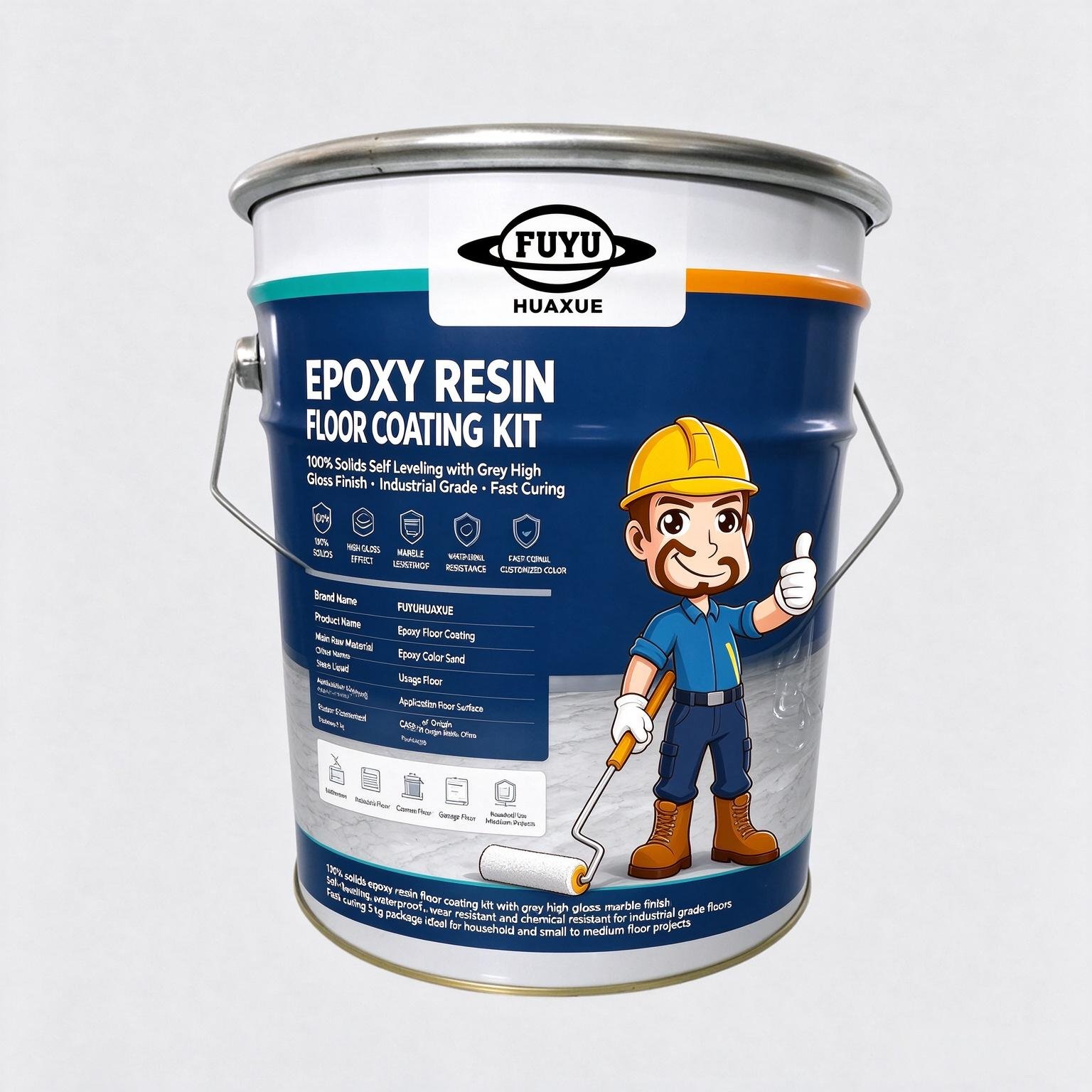
There is a number on every epoxy floor coating data sheet that most buyers skim past, and it is the number that determines whether the floor is still there in a decade. It is not the gloss level. It is not the cure time. It is the solids content—the percentage of the product that stays on the floor after the carrier, if there is one, has left. And the gap between 100% and everything else is not incremental. It is categorical.
A 100%-solid epoxy dries 4 to 8 times thicker than a water-based coating and lasts 10 to 15 times longer. That single relationship reframes the entire purchasing decision. The question is no longer “which coating is cheaper per square meter.” It is “how many millimeters of reactive resin are you actually placing on the slab, and how long do you expect them to survive forklift traffic, chemical spills, thermal cycling, and the slow abrasion of daily operations?”
The market has already begun to answer that question in favor of solids. The premium segment—defined as 100% solids, low-VOC, and certified food/pharma-grade systems—is forecast to grow at 8–11% annually, expanding its share of total industrial epoxy flooring value from an estimated 30–35% in 2025 to 40–45% by 2035. Within the broader industrial floor coatings market, 100% solids formulations are singled out for their zero-VOC profile, improved chemical resistance over traditional coatings, and longer service life in heavy-duty applications. The direction of specification is not ambiguous. The only question is whether the project team understands what it is buying when it chooses a solids-rich system.
What “100% Solids” Means in a Pail and on a Slab
Epoxy consists of resin and hardener. In a 100% solids system, that is essentially all there is. There is no water to evaporate and no solvent to flash off. Every kilogram of mixed material that leaves the pail becomes film on the floor. In a water-based system, a meaningful fraction of the product is carrier that must leave the film to allow cure, which means the wet film thickness and the dry film thickness are not the same number, and the final barrier is thinner, less dense, and more dependent on the substrate beneath it.
The consequence shows up in the failure modes that matter industrially. A dense, non-porous barrier that is integral to the concrete resists heavy forklift traffic, dropped tools, de-icing salts, and oils in a way that a thinner water-based film cannot replicate at the same applied cost. A 100% solids system produces zero VOC emissions and no evaporative shrinkage, which means the film does not pull away from itself as it cures and does not introduce solvent odor into an occupied building. The monolithic surface blocks staining and chemical attack that would otherwise find pathways through a thinner, more permeable film.
This is the technical case, and it is not marketing language. It is the difference between a coating that sits on concrete and a coating that becomes, for practical purposes, the top millimeter of the concrete.
The Grey High-Gloss Finish Is a Working Surface, Not a Showpiece
Grey is not a decorative concession in industrial flooring. It is a specification choice with operational logic. A mid-tone grey surface reflects light without glare, which improves visibility in warehouses, workshops, and garages without the harshness of white or the light-absorption of dark tones. It hides the fine scuffing and tire marking that would be conspicuous on a lighter floor and shows dust and spills clearly enough to prompt cleaning rather than conceal neglect.
The high-gloss finish does more than look finished. A glossy, seamless surface is a cleanable surface. It sheds oil, water, and mild chemical contamination rather than absorbing it, and it can be swept, mopped, or wiped without the surface texture trapping residue. Industrial self-leveling systems are consistently specified for exactly this combination: a smooth, mirror-like, seamless surface that minimizes dust accumulation and is extremely easy to clean and maintain. The gloss is not vanity. It is the visible signature of a film that has leveled properly, cured densely, and sealed the substrate.
Self-leveling application completes the practical case. The material flows to its own level after placement, eliminating trowel ridges and brush marks without mechanical sanding. Industrial self-leveling epoxy at 1–5 mm thickness can be walked on within 12 to 24 hours and reaches full cure in approximately seven days, depending on ambient temperature, with coverage in the range of 0.3–1.5 kg/m² per millimeter of build. That combination—thick build, fast walk-on, seamless finish—is what makes a 100% solids system viable in facilities that cannot afford a week of dark floor.
Fast Cure Is an Operating Decision, Not a Convenience
Cure speed in an industrial setting is never about the contractor’s schedule alone. It is about the cost of the space being unavailable. A warehouse that cannot receive pallets, a food plant that cannot restart a line, a garage that cannot return vehicles—each closed hour has a number attached to it that dwarfs the material cost of the floor.
Industrial 100% solids systems are routinely specified for rapid curing, with walkable times in the 12–24 hour range and full chemical and abrasion resistance developing over the following days. One-coat, high-build, virtually solvent-free epoxy systems can cure within eight hours to withstand light traffic, which is the difference between a floor that disrupts operations for a day and one that disrupts them for a week. The operational value is straightforward: the faster the floor returns to service, the smaller the production or revenue interruption attributed to the coating project.
There is a technical trade-off worth stating honestly. Faster cure generally means a shorter pot life and a narrower window for placement, which places a premium on proper mixing, adequate crew, and disciplined application. A 100% solids system is less forgiving of hesitation than a thin water-based coating. But that is precisely why it is an industrial-grade product rather than a DIY convenience. The material asks more of the installer and returns more to the owner.
Where the Specification Earns Its Keep
The application envelope for a grey high-gloss 100% solids self-leveling system is broad because the performance requirements across industrial and commercial spaces overlap more than they diverge. Warehouses and distribution centers need abrasion resistance under forklifts and pallet jacks. Factories and workshops need chemical resistance against oils, coolants, and cleaning agents. Garages and service bays need hot-tire resistance and easy cleanup of petroleum residue. Food processing and pharmaceutical environments need a seamless, non-porous, cleanable surface that does not harbor residue in joints or texture. Commercial back-of-house corridors and utility rooms need a floor that can be wiped, disinfected, and returned to service quickly.
The same solids-rich chemistry serves all of them, with the grey high-gloss finish acting as a common visual language across a facility. A floor that reads as continuous and intentional from the loading dock to the production line to the maintenance bay is not merely tidy. It is operationally coherent. It signals a building that has been specified rather than assembled.
The environmental profile reinforces the specification rather than complicating it. Zero VOC and no evaporative shrinkage make a 100% solids system a defensible choice for indoor air quality in occupied buildings, and the absence of solvent odor removes one of the most common objections to floor work in sensitive environments. As industrial operators continue to shift toward low-VOC and solvent-free systems to meet sustainability goals without sacrificing durability, the 100% solids category sits on the right side of both performance and compliance.
What to Ask Before You Buy the Kit
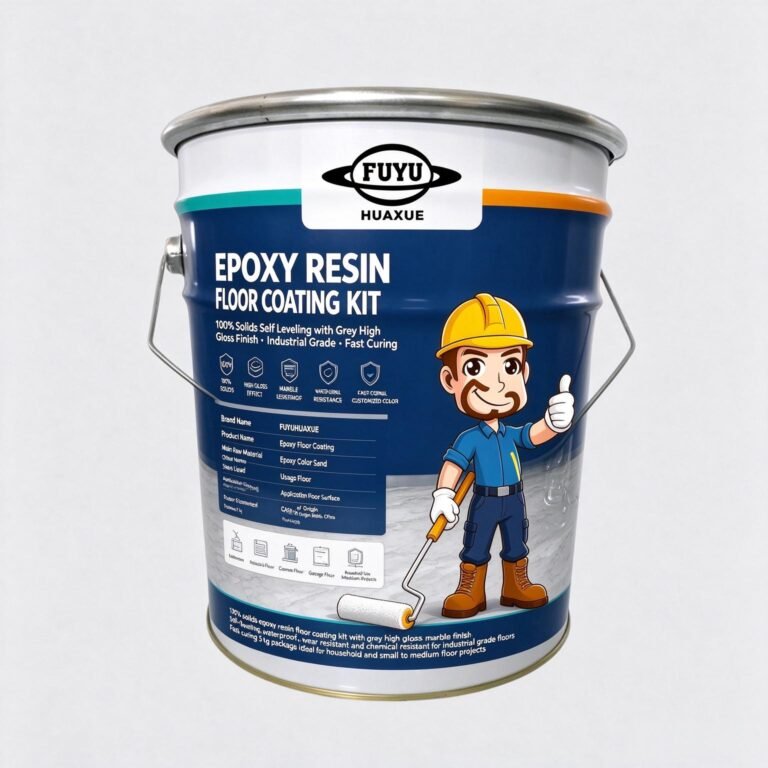
The “kit” format—resin and hardener packaged together in a defined ratio—is the right delivery model for small to medium projects and for maintenance departments that need a repeatable, stockable system. But a kit is only as good as the specification behind it. Three questions separate a genuine industrial-grade 100% solids system from a product wearing the label.
First: what is the solids content, by weight or by volume, and is it stated on the technical data sheet rather than the marketing page? If the number is not explicit, the product is not a 100% solids system, and the thickness-and-lifespan advantages do not apply.
Second: what is the recommended build per coat, and what walk-on and full-cure times correspond to the ambient temperature on your site? A cure time quoted without a temperature is not a specification. A floor that is walkable in 12 hours at 25°C may take materially longer in an unheated space in winter.
Third: does the system include the surface preparation and primer logic, or only the topcoat? A 100% solids self-leveling coat bonds tenaciously to a properly prepared substrate and fails predictably on a contaminated or weakly profiled one. Diamond grinding or equivalent mechanical preparation is not an optional step in the value chain. It is the foundation on which the film’s adhesion depends.
A supplier who can answer those three questions with numbers rather than adjectives is selling a system. A supplier who cannot is selling a pail.
The floor is the only building component that every person, every vehicle, and every load touches every day. It is also the component most often value-engineered into premature failure. A 100% solids, self-leveling, grey high-gloss epoxy kit is not the cheapest way to cover concrete. It is the most direct way to stop thinking about the floor—because the thickness is the warranty, the gloss is the evidence of a sealed surface, and the cure speed is the difference between a project that costs downtime and one that does not.