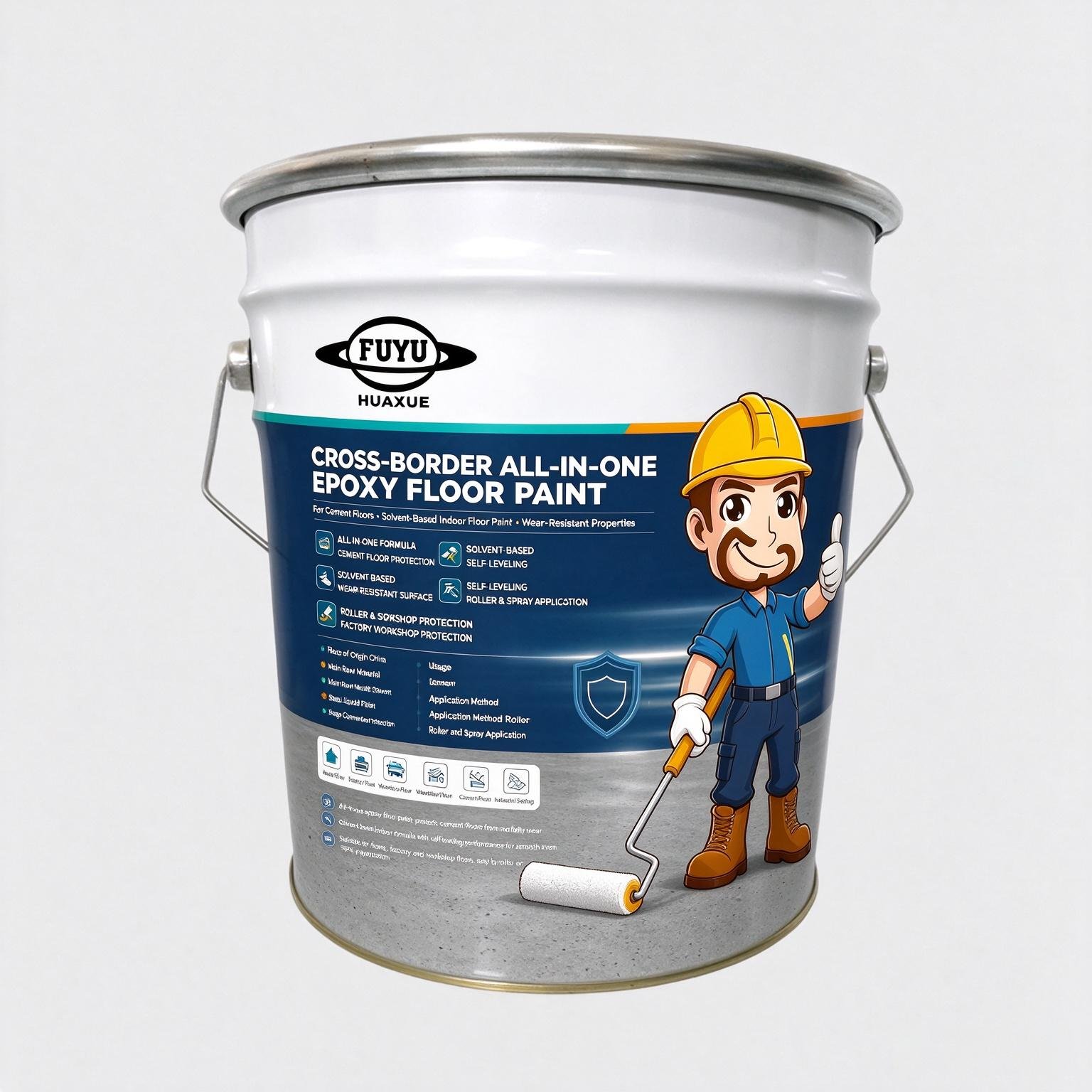
There is a particular anxiety in buying a floor coating from a supplier nine time zones away. It is not the price per kilogram, although that is the number on the quotation. It is the moment the container clears customs and the pail is opened on a jobsite where the concrete is older than advertised, the ventilation is worse than promised, and the crew has never used this exact product before. At that moment, the specification either behaves like a system or it behaves like a gamble. The difference is rarely visible on a one-page product listing.
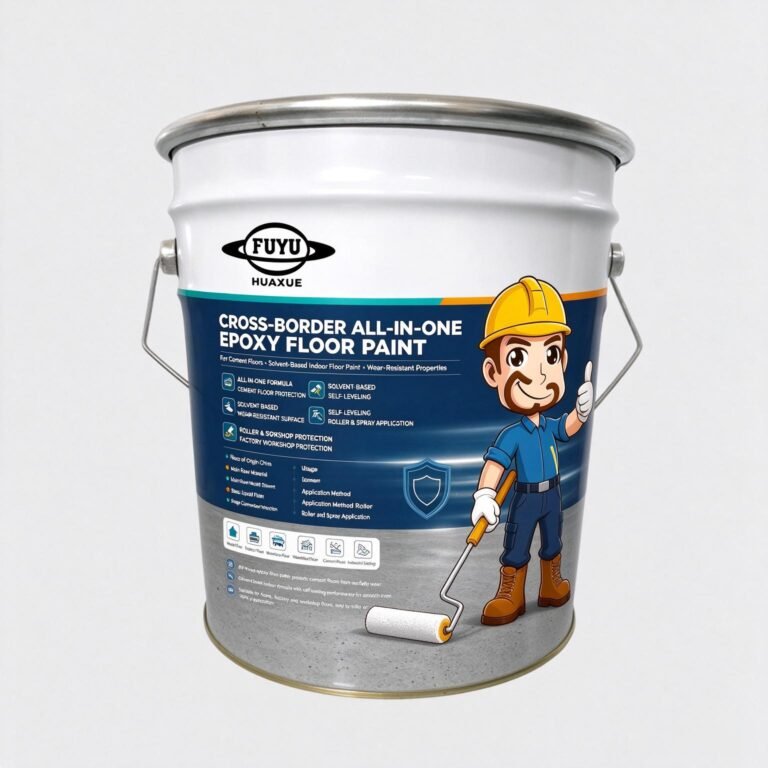
A cross-border all-in-one solvent-based epoxy floor paint for cement floors is, at its best, a response to that exact moment. It is not trying to be the most sophisticated coating in the global catalogue. It is trying to be the coating that arrives intact, mixes predictably, penetrates the substrate it was actually shipped to protect, and cures into a wear-resistant surface without requiring a laboratory’s worth of site conditions. The case for that kind of product is not aesthetic. It is logistical, chemical, and—increasingly—regulatory.
The Number That Matters First: Wear Resistance Is a Film Property, Not a Claim
The global epoxy floor coatings market was valued at approximately USD 1.48 billion in 2025 and is projected to reach USD 2.49 billion by 2033, growing at a compound annual growth rate of roughly 6.8%, with Asia Pacific as the largest revenue-generating region and China expected to register the highest growth rate. Expansion of that scale is not driven by buyers choosing floors because they look good in a brochure. It is driven by the cost of replacing floors that did not survive.
Solvent-based epoxy systems earn their place in that demand because the chemistry produces a film with a specific mechanical profile. Two-component solvent-based epoxy coatings are consistently specified for “good resistance to abrasion and mechanical stress,” “very high adhesion strength,” and resistance to a broad range of chemicals. In industrial floor paint formulations, the combination of epoxy resin and solvent carrier is explicitly associated with “excellent abrasion resistance and impact resistance against heavy loads and frequent traffic,” along with water, chemical, and oil resistance. Heavier-duty trade products in the same category are positioned for concrete and metal substrates “where a more heavy-duty coating is required for heavy-traffic areas,” with resistance to chemicals, solvents, abrasion, and impact treated as a single performance package rather than separate features.
That matters for cement floors because cement is an abrasion machine. Every footstep, every dragged pallet, every steel-toed boot on a workshop floor transfers energy into the coating surface. A film that powders or peels under that load does not merely look worn. It stops protecting the concrete beneath it, and once the concrete is exposed, dusting begins, oil penetrates, and the floor enters the maintenance cycle that consumes facility budgets year after year. The wear-resistant surface is the first line of defense, and the first thing a cross-border buyer should verify is whether the product’s abrasion resistance is a measured film property rather than an adjective.
Why Solvent Still Has a Job on Real Cement Floors
The floor coating conversation has moved decisively toward water-based and solvent-free systems, and that direction is correct for new construction, for occupied buildings, and for projects where indoor air quality is the governing constraint. But a cross-border all-in-one product for cement floors is frequently sold into a different reality: renovation work, older slabs whose surface profile is imperfect, and workshops where the substrate has absorbed decades of oil, dust, and wear.
Solvent-based epoxy has a specific advantage in that environment that is easy to underestimate from a data sheet. The carrier solvents actively penetrate the concrete surface, absorbing into the pore structure before the resin crosslinks. That penetration produces strong adhesion and surface tolerance on imperfect substrates—older concrete, surfaces that have been previously coated, and slabs where mechanical preparation has been less aggressive than a new-build specification would demand. Solvent-based epoxies are described in the technical literature as offering “strong substrate penetration and practical flow characteristics,” with the trade-off that they require adequate ventilation during application and generally produce a thinner film than solvent-free systems.
That trade-off is the honest core of the value proposition. A solvent-based all-in-one is not the right product for a pharmaceutical cleanroom that demands a 3 mm solvent-free build. It is the right product for a factory workshop floor where the concrete is sound but imperfect, the budget is finite, and the coating must penetrate rather than merely sit on top. The solvent is not an impurity. It is the delivery mechanism that allows the resin to reach the substrate that needs protecting.
The Regulatory Line Every Cross-Border Buyer Must Cross
No responsible discussion of a solvent-based product in 2026 can avoid the regulatory context, because the regulatory context is now part of the landed cost. China’s GB 30981.1-2025, which takes effect on June 1, 2026, brings floor coatings under mandatory control and sets a VOC limit of 500 g/L for solvent-borne floor coatings, alongside 120 g/L for waterborne and 60 g/L for solvent-free systems. Crucially, the standard extends mandatory testing to auxiliary materials—putties, color pastes, and curing agents—for the first time, and the certification regime tightens accordingly, with older certificates requiring renewal under the new standard.
For a cross-border buyer, this is not a distant Chinese policy detail. It is a supply-chain filter. Products that cannot document compliance under the new limits become difficult to export through Chinese ports at scale, and the manufacturers without the formulation capability to adjust are exiting the market. A solvent-based all-in-one product that is positioned for export must be able to answer a simple question: what is the VOC content, expressed as a number against the 500 g/L ceiling, and is the supporting test documentation available before the purchase order is signed? A product that cannot answer that question is not a bargain. It is a future customs delay waiting to happen.
The regulatory direction also explains why the “all-in-one” framing is more useful than it first appears. A single-component purchase that bundles resin, hardener, and application guidance reduces the number of documentation failures a buyer must manage. The fewer the pails and the fewer the suppliers, the fewer the compliance interfaces that can break between the factory gate and the finished floor.
The Ningbo Factor: Port Reality as a Product Feature
There is a reason “Ningbo” belongs in the product description and not only in the shipping documents. Ningbo and Ningbo-Zhoushan are established departure points for coating exports, with epoxy floor paint shipments moving through the port under HS code 3907301000 and related resin classifications, and China Customs has been piloting a smart HS code pre-review channel at major ports including Ningbo to reduce classification friction for coating exports. A product sourced through that channel benefits from a logistics ecosystem that already understands what a coating shipment is, how it must be classified, and what documentation it requires.
That does not make the product good. It makes the product reachable. For a buyer in Southeast Asia, the Middle East, Africa, or Latin America, the practical difference between a supplier who can consolidate a mixed order, produce the export documentation, and route through a port with coating-export familiarity and one who cannot is the difference between a floor project that starts on schedule and one that starts with a demurrage bill. The port is not the coating. But the port is part of the system that delivers the coating, and a cross-border all-in-one proposition is only as credible as its logistics tail.
Roller and Spray: Application Latitude as Risk Reduction
The specified application methods—roller and spray—are not incidental. They describe a product with enough viscosity latitude to be applied by the methods a local crew actually has available, rather than the method a laboratory assumes. Roller application suits small-to-medium areas, walls, and edges where a squeegee or trowel is impractical. Spray application covers large open floor plates quickly and produces a uniform film where consistent thickness matters. A product that supports both reduces the number of specialized tools a buyer must import alongside the paint, and it reduces the risk that a crew unfamiliar with the product will default to a method the formulation was not designed for.
Self-leveling behavior in a solvent-based system works differently from a 100% solids self-leveling pour. In a solvent-based coating, the carrier solvent assists flow and leveling before it leaves the film, which helps the coating flatten out and penetrate the substrate, but the final film is thinner than a solvent-free self-leveling build. That is not a defect. It is a different tool for a different job. The product is designed to protect a cement floor with a wear-resistant, chemically resistant film that conforms to the substrate and cures without the thickness and cost of a heavy-build system. For workshop floors, light industrial bays, garages, and storage areas where the concrete is the structure and the coating is the barrier, that is the correct trade.
What “All-in-One” Should Mean to a Buyer
The phrase “all-in-one” is overused in cross-border trade, and it usually means only that the resin and hardener ship in the same carton. The version worth paying for means something more specific: one purchase that resolves the adhesion question on a real cement substrate, one formulation that supports the application methods the local crew possesses, one wear-resistant film that does not require a specialty contractor to install, and one documentation package that can survive the regulatory tightening already underway. It does not mean the product is right for every floor. It means the product removes the most common reasons a cross-border floor purchase fails—wrong substrate assumption, wrong application method, wrong documentation, wrong expectations about film thickness.
The buyers who get this right are not the ones who find the lowest price per kilogram. They are the ones who ask three questions before the container ships: What abrasion and adhesion performance does the film deliver on prepared cement, supported by a test number rather than a phrase? What is the VOC content against the 500 g/L solvent-borne limit, and can the certificate be produced before the order? And through which port and under which HS classification will the shipment move, so that the documentation matches the product? A supplier who can answer those three questions with specifics is selling a floor coating. A supplier who cannot is selling a pail with a label. The difference only becomes visible after the floor is down—and by then, the ocean has already been crossed.